
The Visual System in Basketball
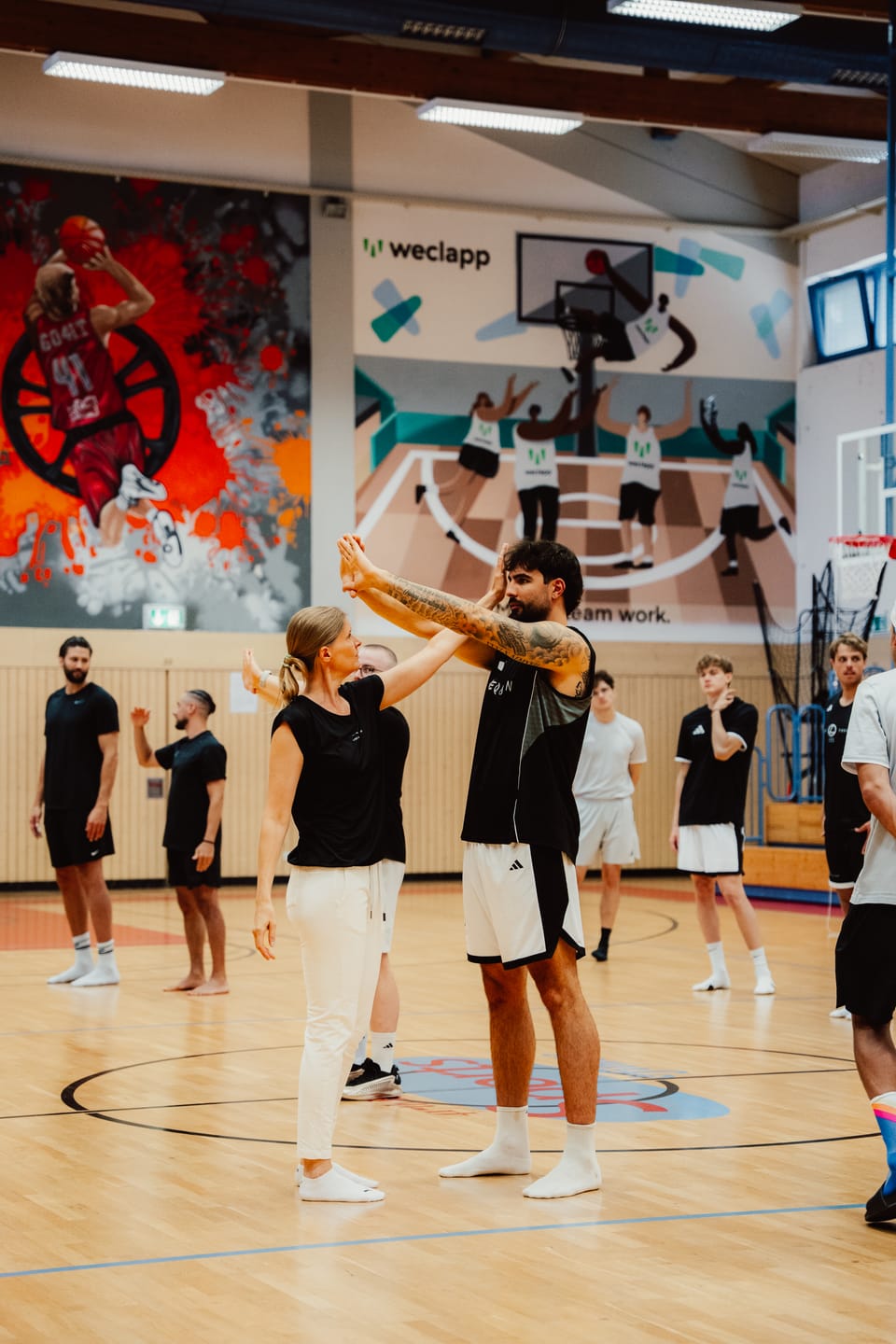
The visual system plays a central role in the nervous system and is one of the most important factors for improving athletic performance. Our eyes control around 70 % of our posture and provide 70–90 % of all sensory information. The remaining 10–30 % comes from the senses of smell, taste, touch and hearing. Cranial nerves II, III, IV and VI play a decisive role in the visual system.
The eyes act as a kind of danger filter for the central nervous system. The better a game situation is visually perceived and assessed, the more accurately the further course of play can be predicted. This improves anticipation and decision-making during a game.
The four most important core skills that should be trained are visual acuity, peripheral vision, eye movements (saccades and pursuits) and depth perception (judging distances).
Limited visual abilities can be identified with targeted neuroathletic assessments (tests) and specifically trained.
Possible effects of limited visual abilities, illustrated by selected examples
Problems with visual acuity
Strikingly often, players who wear contact lenses (during training or games) or glasses (in everyday life) perceive different levels of visual acuity without being aware of it.
Differences in visual acuity, whether for near or distance vision, have an immediate impact on playing behaviour:
- Decisions are made with a delay
- Passes are less precise
- Shooting percentage drops
- Playing speed is reduced
- Endurance performance decreases
- Anticipation and reaction ability decline
Problems with peripheral vision
If the peripheral visual field is perceived only to a limited extent, players tend to favour one side of the court when moving or playing.
Problems with binocularity (binocular vision)
Distances and depth are judged inaccurately, which has a negative effect on catching and passing, as well as on precision shots.
Problems with eye movements
If a player cannot keep the ball constantly in view during a pass, or if the eyes constantly have to readjust when switching between opponent, ball and basket, the player's performance drops significantly.
Sports hall
Every sports hall offers different visual conditions – for example due to varying wall colours, floor surfaces, artificial lighting or incoming daylight. Colours and lighting conditions influence the processing of visual stimuli in the brain and can therefore alter performance – for example visual acuity or concentration.
This could explain why players perform better or worse in some halls.